



Solution Architecture Thinking
Two different worlds, two different decision logics
A facility owner sits with three quotes spread across the desk for an audiovisual system in a major institutional building. The quotes look almost identical: similar equipment lines, similar pricing, similar warranty terms. After meeting all three vendors, however, something feels different. One of those meetings felt strange, and at first the owner cannot articulate why.
The strangeness is in the first question.
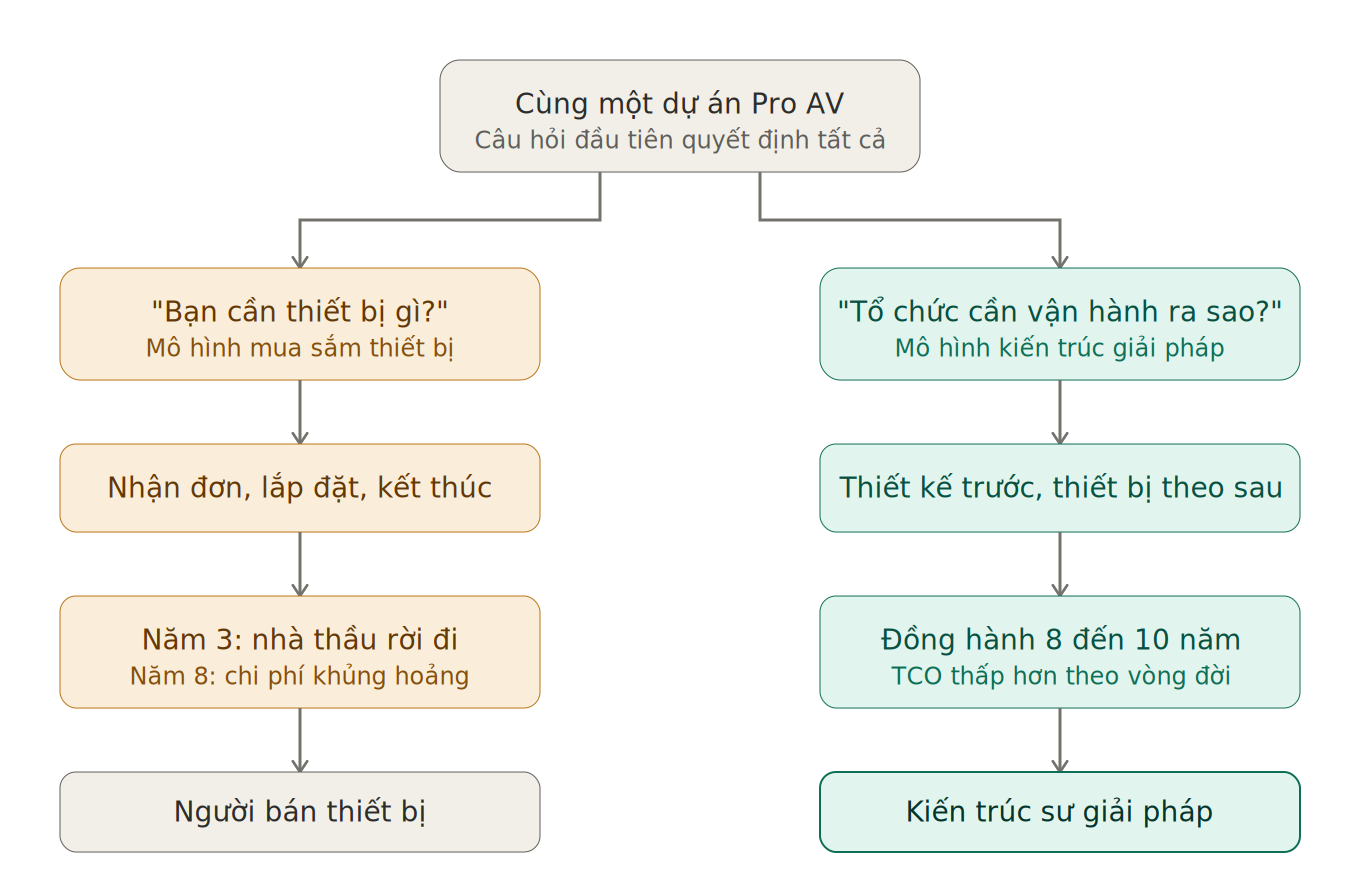
Two of the three vendors opened with the same question: "What equipment specifications do you need?" The third vendor opened with a different question: "How does your organization need to operate, communicate, and make decisions ten years from now?"
That single difference at the opening reveals two completely different operating models. Not minor stylistic variations of the same model. Two fundamentally different approaches to what Pro AV is, what it does for an institution, and what it means to deliver it well.
This document explains why Bá Hùng has consistently chosen the second approach over twenty-three years, and why we believe this distinction matters more than any single product, certification, or technical specification we could list.
When a vendor's first question is "what do you need," the implicit assumption is that the customer already knows the answer. The vendor's role becomes order-taking and execution. The model is procurement.
The procurement model works for commodity goods. It works for office furniture, generic IT equipment, standard building materials. Customer specifies, vendor supplies, transaction completes.
Pro AV in institutional facilities is not a commodity. The customer rarely knows exactly what is needed, because the question is not really about equipment. The real question is how a major auditorium will support eighteen years of provincial government deliberations, how a corporate headquarters will conduct hybrid board meetings across three time zones, how a teaching hospital will preserve fidelity in surgical case conferences shared across multiple institutions, how a university lecture hall will adapt as pedagogical methods evolve over two decades.
These are not procurement questions. These are architecture questions.
When a vendor opens with "what equipment do you need," they have already committed to the procurement model. They will deliver equipment competently. They cannot deliver architecture, because they are not asking the architectural questions.
When a vendor opens with "how does your organization need to operate," they have committed to the architecture model. The equipment becomes a downstream consequence of architectural decisions, not the starting point.
These are not different points on a spectrum. These are different mental models that produce different deliverables, different cost structures, different operational outcomes, and different relationships with the customer over time.
Bá Hùng was founded in 2003 to serve Vietnam's most demanding institutional projects: provincial government chambers, central financial institutions, leading public hospitals, top-tier universities, large national conference centers. These are facilities where errors are not commercially recoverable. A flawed audiovisual system in a provincial people's council chamber is not a billing dispute. It is a public failure with political consequences.
Working in this environment for over two decades produced a simple realization. Equipment quality matters. Brand reputation matters. Installation craft matters. But none of these are sufficient when the underlying architecture is wrong.
We have witnessed projects where premium equipment from leading manufacturers was installed by competent technicians, and the system still failed in operation. Not because of equipment defects. Because the architecture had been outsourced to whoever happened to write the equipment specification, often someone with deep equipment knowledge but no understanding of how the institution would actually use the room across its operational lifecycle.
We have also witnessed projects where moderate-tier equipment was installed within a properly architected solution, and the system delivered exceptional outcomes for years. The difference was not the equipment. The difference was that someone had thought architecturally before procurement decisions were made.
This pattern, observed across hundreds of projects in Vietnam's most demanding facilities, is the foundation of how Bá Hùng works.
A useful comparison comes from building architecture. When constructing a major facility, the architect is responsible for the overall design: how the building will function, how spaces will flow, how form serves purpose, how materials and systems work together coherently across decades of use.
The architect does not personally fabricate windows. Window fabricators do that. The architect does not personally lay bricks. Masons do that. The architect does not personally manage on-site electrical wiring. Electricians do that.
But the architect determined where windows would be, what they should do for the building's experience, how they should integrate with the structural and aesthetic logic of the whole. Without architectural decisions, even the best window fabricator can only produce a generic product placed in an arbitrary location.
Building architecture and Pro AV architecture share this structure. Pro AV equipment manufacturers produce excellent equipment. Pro AV installers can install that equipment competently. But the question of which equipment, where, why, and how it will function as a coherent system across the facility's operational lifetime belongs to a separate discipline.
That separate discipline is what Bá Hùng practices. We call it solution architecture, though the underlying activity is identical to what an architect does for a building.
This is not a marketing positioning. It is a description of what we actually do, distinct from what an equipment dealer does, distinct from what an installation contractor does.
Solution architecture thinking produces a structural consequence. It creates five distinct roles that Bá Hùng must perform across a project's lifecycle, because these roles flow from the architectural commitment.
Role one is solution architecture consulting. This begins before MEP drawings, before bills of materials, sometimes before the customer has fully formulated what they need. The role shapes the entire system architecture based on how the institution will operate over the next ten years, not based on available equipment catalogs.
Role two is direct distribution of specialized equipment. After the architecture is determined, equipment is selected to execute that architecture. Bá Hùng maintains direct partnership relationships with specialized brands in G7 countries, the United Kingdom, and continental Europe rather than purchasing through regional intermediaries. This supply chain structure is a prerequisite for what comes next.
Role three is technical integration and installation. Equipment placed within the designed architecture, not installed against a fragmented bill of materials. This phase is easily confused with "installation contractor work," but the distinguishing characteristic is integration with complete architectural documentation that can be traced to specific design decisions.
Role four is long-term lifecycle maintenance. Systems operate for eight to ten years after handover. An equipment contractor has no economic incentive to remain engaged through this period because their revenue was collected at delivery. Bá Hùng remains engaged because our architecture only proves itself across time.
Role five is rapid response with pre-built playbooks. When incidents occur during high-stakes events, there is no time to call distributors or consult engineering forums. Pre-built response playbooks must exist, with personnel trained to execute them. This role does not exist in the equipment contractor model because pre-built playbooks are products of architectural thinking, not transactional thinking.
These five roles are not a marketing menu we offer optionally. They are structural consequences of solution architecture commitment. Cutting any one of them would mean we are no longer doing solution architecture.
The clearest demonstration of architectural thinking versus equipment thinking is something we call Multi-tier Anti-Feedback architecture, which achieves microphone pickup distance of 160cm in large auditoriums.
For context, standard short-stub conference microphones operate effectively at 40 to 60cm pickup distance. Long gooseneck microphones extend this to 60 to 80cm. Beyond that, the industry has historically accepted feedback risk as a physical wall. The standard accommodation is the familiar gesture of speakers leaning forward toward microphones during important moments. This gesture is so universal that we no longer notice it, but it is a quiet admission of system limitation.
Bá Hùng's Multi-tier Anti-Feedback architecture achieves stable 160cm pickup. This is double the industry standard. The mathematical foundation is the inverse-square law: at 160cm, sound intensity at the microphone is one sixty-fourth of the intensity at 20cm, requiring approximately 18 decibels of additional gain to compensate.
This 18dB gain is impossible for any system that approaches the problem at the component level. No single microphone, no single DSP unit, no single loudspeaker, no single calibration choice can produce this much feedback headroom alone.
It becomes possible only through a multi-tier architecture in which five layers operate simultaneously: room acoustic design, loudspeaker directivity and placement strategy, digital signal processing, gain staging architecture, and field calibration in the actual operational environment.
This is what we mean by architecture as opposed to procurement. An equipment contractor purchases the best available microphones and amplifiers. A solution architect designs a multi-tier processing chain that exceeds what any individual component can deliver.
The 160cm distance is also not our default configuration. It is a documented technical ceiling, achieved in optimal conditions. Most rooms operate at far shorter distances in actual use. The value of designing toward 160cm for smaller rooms is the operational safety margin it provides. A system designed for 160cm at the edge of stability operates at 60cm with 18dB of feedback headroom in reserve, which absorbs voice variation between speakers, calibration drift over time, acoustic changes from furniture or curtains, and operator inconsistency.
This is the difference customers actually experience. Not the 160cm specification on a technical report, but the operational stability across years of daily use.
The two approaches look identical at delivery. Year one brings no apparent difference. Both systems operate, both teams seem competent, both contractors are responsive.
Year three reveals the first divergence. The equipment contractor has moved on to other projects. Their original engineers have rotated. When a problem arises, the customer initiates ad-hoc service, often through a different contractor who must diagnose the system from scratch without project history.
The solution architect remains engaged. Maintenance follows a documented schedule. The same engineers, or engineers who have inherited proper handover documentation, continue to know this system.
Year five tests the supply chain. Components begin to age. The equipment contractor's customer discovers that some original equipment has been discontinued by the manufacturer, that compatible replacements may not exist, that upgrading one component triggers a chain of compatibility issues elsewhere.
The solution architect's customer discovers that the lifecycle plan written at design time anticipated these failures. Genuine replacement parts are available because of direct manufacturer relationships maintained for exactly this purpose.
Year eight brings the refresh question. The equipment contractor's customer faces an unplanned major capital expenditure decision because the original equipment is functional but increasingly fragile, and partial upgrades create compatibility problems.
The solution architect's customer has been planning for this since year five, with refresh roadmaps mapped against budget cycles and operational priorities.
Year ten reveals total cost of ownership clarity. Industry analyses consistently show that lifecycle service models deliver lower total cost across ten years, despite higher initial capital expenditure, because of avoided crisis costs in the middle years.
This is not a hypothetical comparison. It is the predictable outcome of two different starting decisions: equipment contracting versus solution architecture.
For procurement teams, facility managers, and executive sponsors evaluating Pro AV vendors, three questions reveal which model a vendor actually operates in.
The first question is about lifecycle: "Year eight after handover, what state will this system be in, and what is your refresh roadmap? Are you prepared to commit that roadmap into the contract?" Solution architects answer with specific roadmaps and welcome contractual commitment. Equipment contractors typically deflect because lifecycle is not part of their business model.
The second question is about architecture: "For the highest-risk failure mode in this facility's operational profile, what architectural prerequisites are required for rapid recovery, and does your proposed design satisfy them?" This question is not a trap. It exposes the disconnect between rapid response promises and the architectural reality required to deliver on them. Solution architects answer concretely. Equipment contractors typically struggle because rapid response was never designed into the architecture from the beginning.
The third question is about supply chain: "For each major equipment line in your proposal, what written commitment do you have from the manufacturer regarding spare parts inventory after the model is discontinued? Specifically through what year?" Direct manufacturer partners produce written documentation with specific year commitments. Vendors purchasing through intermediaries typically do not have such documentation.
These three questions distinguish the two models more reliably than any technical specification comparison.
Solution architecture is not the appropriate choice for every Pro AV project. A small office meeting room with five-year operational horizon, no high-stakes use cases, and no political or operational visibility is well-served by the equipment contractor model. The architecture overhead would not justify itself economically in such cases.
But for facilities where errors are not commercially recoverable, where operational continuity matters, where the institution has decade-plus operational horizons, where reputation and legal compliance intersect with system performance, solution architecture is not an upgrade option. It is the correct discipline for the work.
Bá Hùng was founded to do this work. We chose this position deliberately in 2003, and we have refined our practice across hundreds of projects since. We are not the appropriate vendor for every Pro AV project in Vietnam, and we do not pursue every project. We are the appropriate vendor when the project actually requires architectural thinking.
That is the distinction this manifesto exists to make clear.
→ Read the second manifesto: Direct Partner Network | Return to About Us
Bá Hùng Technology
· Technology Solution Architect
· Established 2003